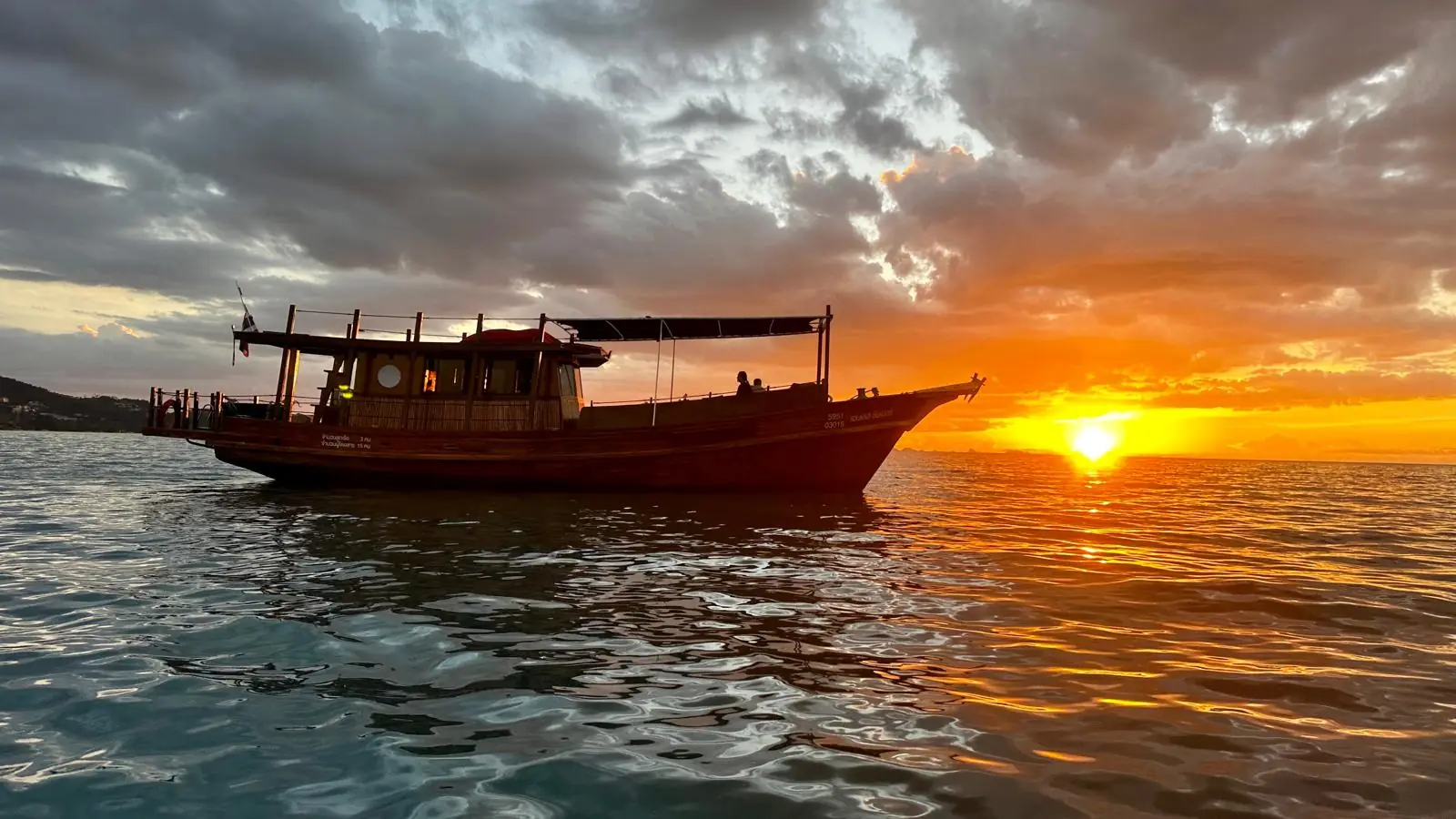
Koh Samui rainy season: what November and December are really like from the boat
By the Endless Summer crew · · 10 min read
Some links in this article go to GetYourGuide, which pays us a small commission if you book. It costs you nothing extra, and we only link trips we would send a friend on.

The Koh Samui rainy season is happening as we write this. From about mid-October to mid-December the north-east monsoon sets the weather here, and November is the wettest month of the year. It is the stretch when we are most likely to move a trip.
This is the honest version, from the crew of a slow wooden boat that works the north and east coasts Monday to Friday. Some days are grey and wet. Many are not. Here is what the season actually looks like, which parts of the coast cope best, how we decide whether a trip goes out, and what to do on land when it pours.
When is the Koh Samui rainy season?
Samui’s rainy season runs from roughly mid-October to mid-December, with November the peak. November averages several hundred millimetres, more than any other month. That catches people out, because the rest of Thailand runs on a different calendar: Phuket and the Andaman coast get their wet season from about May to October, which is exactly when Samui tends to be at its best.
The useful thing to know is that it ends. From late December the wind eases, the swell drops and the Gulf goes back to the calm water most people picture. If you are still choosing dates rather than coping with them, our month-by-month guide to the best time to visit Koh Samui covers the whole year.
| Period | What to expect | Boat days |
|---|---|---|
| Mid to late October | Showers building, wind turning north-east | Most run; some route changes |
| November | Wettest month, heaviest bursts, rougher sea on the east coast | Highest chance of a move or cancellation |
| 1 to mid-December | Still unsettled, often brighter spells | Mixed; improving towards the end |
| Late December onwards | Seas settle, drier, calmer | Back to normal |
What a rainy day on Samui actually looks like
Most rainy-season days are not wet all day. The common pattern is a heavy burst, often with wind ahead of it, that lasts anything from ten minutes to an hour, then sun again and steam coming off the road. You see it coming across the water long before it reaches the boat.
Digby, who came out with his family, described it better than we could on Google: “For a brief moment we were caught in a rain storm, which was very atmospheric and in our view was part of the experience. It lasted only 20 minutes and the rest of the time it was sunny.” That is a very typical monsoon trip.
The other pattern is less fun, and we would be lying if we left it out. A few times each season a weather system sits over the Gulf and it rains steadily for a day or two, sometimes longer. Low-lying roads, especially around Chaweng and Lamai, can flood for a few hours after a heavy downpour, and the beaches on that side often fly red flags because of rough surf and currents. It is still warm throughout, usually high twenties, so being wet is rarely the same as being cold.
Which coast gets the swell in the Koh Samui monsoon season?
The east coast takes the swell first. The north coast is sometimes easier, but a strong north-easterly makes it rough too; the crew decide on the day.
On the east side that means Chaweng, Lamai and the boulder coves between them, including Silver Beach (Crystal Bay) and Coral Cove, where our half-day trip normally stops to snorkel. On a windy November day that stretch can be all white water. The north coast runs from the Big Buddha at Bangrak through Bophut and Mae Nam to Bang Po, and it is where the Sunset Cruise spends its evening.
Why a slow, heavy wooden boat often still works in November
A heavy hull at low speed copes with monsoon chop far better than a fast, light one. Endless Summer is a 14.7 m handcrafted Thai teak cruiser with a displacement hull, and she cruises at around 6 to 7 knots. She moves through a short sea instead of jumping off the top of it, so the ride stays steady when a speedboat would be slamming. Slowness is the point most of the year; in November it is also the comfort.
Rain matters less than you would think on board. There is a shaded cabin and a shaded stern, so when a shower comes through people move under the roof, the playlist keeps going and twenty minutes later everyone is back up on the roof deck. Swimming in warm rain at anchor is one of the nicer things you can do here.
What a slow boat does not do is make a rough sea safe, and it does not fix the water. After heavy rain the sea near the shore is often cloudier, so snorkelling on the half-day trip can be less clear than in March. The sunset cruise stays on the north coast and has no snorkelling stop, so cloudy water matters less. It runs from 16:00 to about 19:30, heading west past Fisherman’s Village and along Mae Nam to the open water off Bang Po, with a swim stop around 17:30.
How we decide whether a trip runs
The crew make the call, and it is a safety call about the sea, not about whether the sky looks grey. They look at the wind, the swell and the forecast for the hours we will be out.
There are three outcomes. Often the trip runs as planned. Some days it runs with changes: the crew adjust the route for sea state, so on the half-day trip the Silver Beach stop might move to a neighbouring cove, be shortened, or the morning might stay on the north side. And some days it does not run at all.
If we cancel for weather or safety, you choose a free reschedule or a full refund, with nothing deducted. The crew tell you on WhatsApp as early as they can. The same applies if a shared departure does not reach its five-guest minimum.
How to plan a boat trip in November and early December
Book early in your stay, not on your last day. Our shared trips run Monday to Friday, so if you arrive on a Saturday and book the Monday, there are four more weekdays to move to if the sea says no. Book your final Friday and a cancellation simply means a refund.
- Pick an early weekday. Every day you leave after the booking is a day the trip can move to.
- Book before the cut-off. Website bookings close 24 hours before departure, Bangkok time, and you can cancel free of charge up to 24 hours before.
- Watch the morning, not the app. Forecast apps show rain icons for whole days in November. Look at the sky and the sea from your balcony at breakfast; a bright morning often holds.
- Keep your phone on. Pickup times and the boarding point, Petcharat Marina in Bangrak or Hansar Samui Resort in Bophut, are confirmed on WhatsApp, along with any weather change.
- Choose the sunset trip if snorkelling is not the point. The sunset cruise stays on the north coast and has no snorkelling stop, so cloudy water matters less.
Ang Thong is closed from 1 November to 15 December
Ang Thong National Marine Park is closed to visitors every year from 1 November to 15 December. If the emerald lake and the viewpoint are on your list, plan them for after the reopening, and allow for the first days back being weather-dependent too.
We do not go to Ang Thong on any trip, so this does not change our schedule. It does change the island’s: the Ang Thong join-in day trips do not run in that window. If you are weighing up that trip for later in your holiday, our Ang Thong day trip vs a small boat piece sets out the differences.
What to pack for the rainy season on Koh Samui
Pack for warm rain, not cold weather. A heavy jacket is wasted luggage here; a thin waterproof is not.
- A light rain jacket or packable shell.
- A small dry bag or zip pouch for your phone and cash.
- Quick-drying clothes and sandals you do not mind soaking. Cotton stays wet for hours in this humidity.
- Coral-safe sunscreen, a hat and sunglasses. Cloud does not stop the sun between showers, and the burns in November are real.
- A light layer for the Sunset Cruise, when the breeze picks up on the way back.
- Seasickness tablets if you are prone, taken before you board rather than once you feel it.
Rainy day activities on Koh Samui
The best rainy-day plans are under a roof and easy to drop when the sun comes back.
- Learn to cook Thai food. A cooking class fills a wet morning and you eat the results. This Thai cooking class with a Samui local family is a good one to have in reserve.
- Visit the [Big Buddha](/blog/big-buddha-koh-samui) between showers. Wat Phra Yai sits on Koh Faan, the islet joined to the island by a causeway at Bangrak. The 12 m golden Buddha is quick to visit and looks its most dramatic against a dark sky. You also see it from the water on our half-day route.
- Add Wat Plai Laem on the same trip. It is a short drive from the Big Buddha, a temple set on a lake with a large white statue of Guan Yin with many arms, and most of it can be seen in under an hour.
Two things to skip in heavy rain: the island’s waterfalls, where the rocks get slippery and the water gets powerful, and long scooter rides, when wet roads, sand washed across bends and flooded dips are the season’s real hazard.
Questions people ask us
- What is the rainy season in Koh Samui?
- Koh Samui’s rainy season is the north-east monsoon, roughly mid-October to mid-December, with November the wettest month. It runs opposite to Phuket, which is wet from about May to October. Rain usually comes in heavy bursts with sunny spells between, though a few spells each season bring a day or two of steady rain. The east coast takes the swell first.
- Is November a good time to visit Koh Samui?
- November is fine if you are flexible and want quieter beaches, and a poor choice if you need guaranteed sun or calm sea every day. It is the wettest month, Ang Thong is closed and some boat trips get moved. Book boat days early in your stay and keep a rainy-day plan ready, such as a cooking class.
- Which month to avoid Koh Samui?
- If you want the best odds of sun and calm sea, November is the month to avoid, with mid-October and the first half of December close behind. That is the north-east monsoon. It is not a washout, and plenty of trips still run, but it is the stretch with the most rain and the highest chance of a boat day being rescheduled.
- What is Koh Samui’s weather like in December?
- Early December is still unsettled, with showers and some rough days on the east coast, but brighter spells become more common as the month goes on. By late December, including Christmas, the seas usually settle and the weather turns drier, the start of the calm season that runs to about April. Ang Thong is closed to visitors every year from 1 November to 15 December.
- Do boat trips run in the Koh Samui rainy season?
- Many do. Our half-day trip and sunset cruise run Monday to Friday through the monsoon whenever the crew judge the sea safe, with routes adjusted for conditions. If we cancel for weather, you choose a free reschedule or a full refund. Booking early in your stay gives the trip room to move.
Come out on the water with us
One handcrafted Thai teak cruiser, fifteen guests at most, free hotel pickup anywhere on Koh Samui.